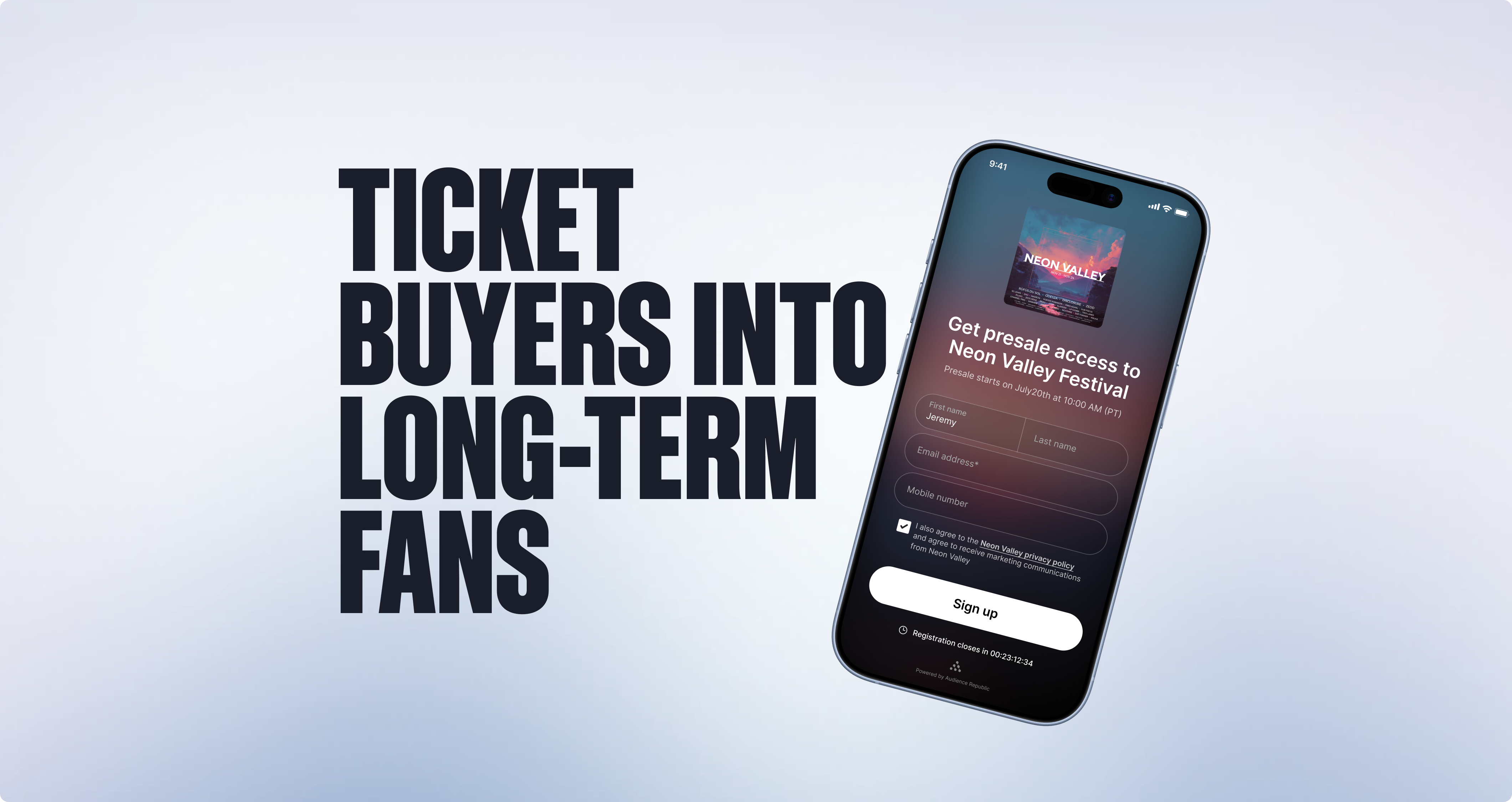
Every ticket sale is an opportunity to build first-party data, not just generate revenue. It closes with the same moment: a confirmation email, a QR code, a line item in a settlement report — and it's tempting to stop there, to treat the sale as the finish line. But for the buyer, the transaction is the beginning of a relationship with your brand, not the end of one. The organizers who understand this, and build their marketing around it, are the ones filling rooms twice as fast the next time around.
Treat every buyer as a one-time transaction and you're stuck re-earning your entire audience from scratch, every single event. Even at the most loyal recurring festivals and residencies, year-over-year buyer overlap is consistently lower than most organizers assume the majority of any given edition's audience is typically new, not returning. Most organizers are quietly rebuilding their audience from zero, again and again, because they never turned those buyers into first-party data in the first place.
That's an expensive habit, and the math compounds:
If you can't identify who that group is, you can't market to them, and you're leaving your highest-value relationships on the table.
A single ticket purchase carries far more signal than a payment record. Captured and connected properly, it becomes first-party data you can act on: a fan profile, not a row in a settlement spreadsheet. A single purchase can tell you:
That's what lets you spot the past attendee who hasn't rebought yet and send them a nudge before they drift, rather than a generic blast after the room is already half full.
Picture a 1,500-capacity venue running a monthly residency night. Six months in, ticketing data alone shows attendance. First-party data shows something sharper: the fans who've bought three or more nights running, the price point that consistently sells out first, and the window where most tickets move. That's the list the venue emails the moment the next date goes live — and the reason the room fills before a single ad dollar is spent.
Most organizers can't see any of that, because ticketing, CRM, and marketing tools operate as three separate systems that don't talk to each other. The data exists; it just isn't usable. Organizers who close that gap and centralize attendee data see meaningfully stronger conversion than teams still stitching attribution together manually after the fact. The data was always valuable — it was just locked in silos.
None of this requires a radical overhaul, just a shift in what you consider the actual deliverable of a sale: treating every transaction as a chance to grow first-party data, not just close it. It's exactly the gap Audience Republic was built to close — every ticket sold through your existing provider, whether that's Ticketmaster, Eventbrite, AudienceView, or another platform, flows into a single fan CRM alongside email, SMS, and gamified pre-sale activity, so you're not reconciling three exports before you can send one campaign.
A few things separate organizers who put that first-party data to work from those still treating buyers as transactions:
The organizers pulling ahead right now aren't necessarily running bigger events. They're running the same events with a longer memory, one where every buyer who walks through the door becomes easier, not harder, to bring back next time. That compounding effect, more than any single campaign, is what turns a calendar of one-off shows into a durable, first-party-data-driven business.
See how Audience Republic turns every ticket buyer into a fan profile you can market to, automatically. Take a product walkthrough by yourself here.
Amy Gallo, "The Value of Keeping the Right Customers," Harvard Business Review, October 2014, citing research from Bain & Company.