Braze is one of the leading customer engagement platforms, but is it the right CRM for live event marketing? If your goal is selling more tickets, growing first-party fan data, and connecting every campaign back to ticket sales, it's worth understanding how Braze compares to platforms built specifically for the live events industry, like Audience Republic.
This guide breaks down where each platform is strongest, where each one asks you to do extra work, and most importantly which one fits your business. Braze for live event marketing can work, but it wasn't built for it. Here's what that means in practice, and how to decide between the two.
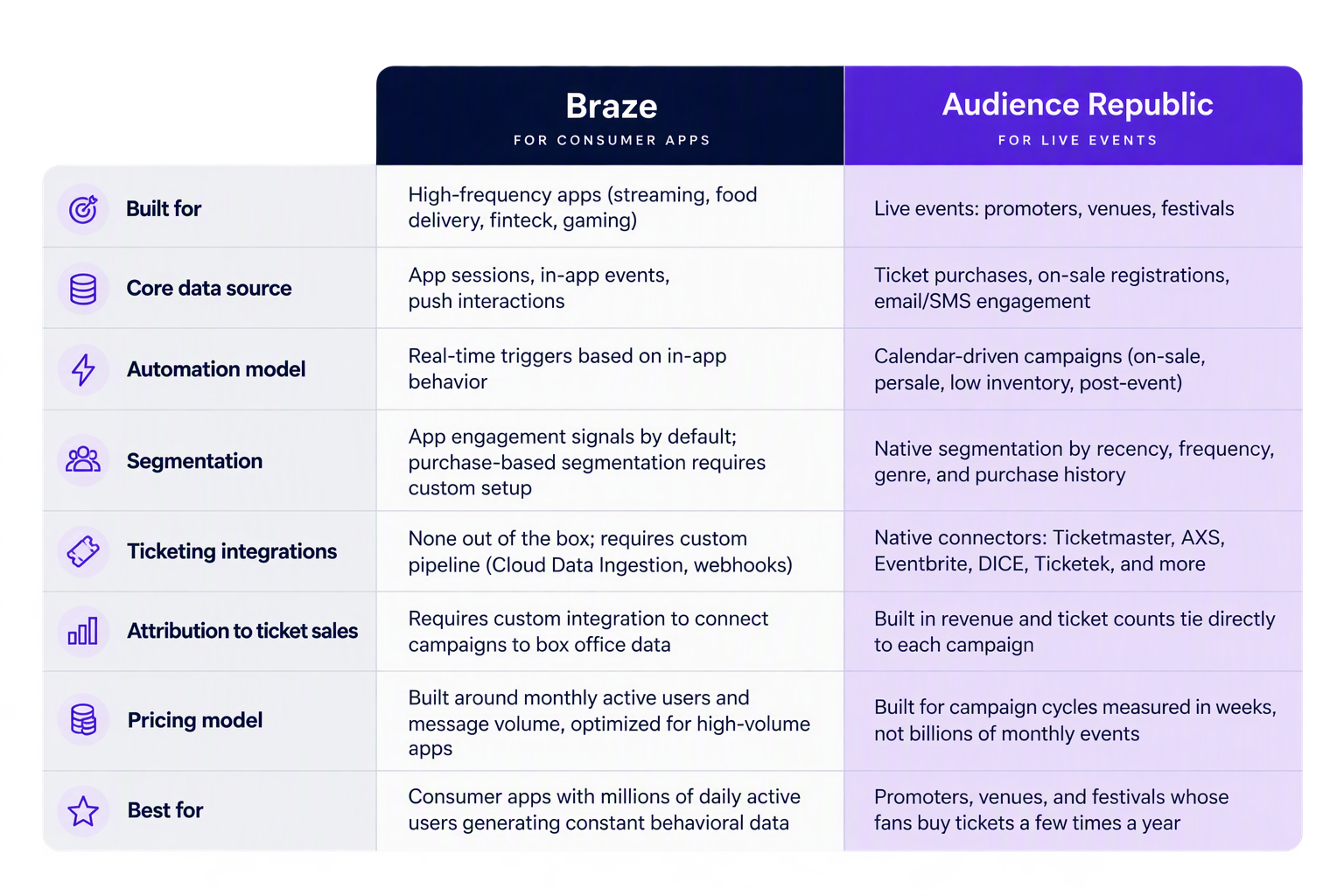
Braze is a genuinely sophisticated platform, used by some of the biggest consumer brands in the world streaming services, food delivery apps, fintech, mobile games. It was built to orchestrate personalized, real-time communication for the app you open every morning, the service you engage with multiple times a week.
Live events don't work that way. Fans buy tickets a few times a year, when the right show hits at the right moment an episodic pattern, not a daily habit. That single difference is what shapes everything else in this comparison: what data each platform needs, how automation is triggered, how fans get segmented, and how campaigns get priced. The sections below walk through what it means for your team in practice.
Choose Braze if your business runs on a mobile app that generates constant behavioral data every session, screen view, and tap becoming an event the platform can act on. That's the fuel behind Braze's real-time personalization and trigger logic, and it's genuinely powerful for products people open daily.
Most promoters and venues don't have that. And the ones with an app usually find fans only open it around an announcement or when they have a ticket in hand not the high-frequency traffic Braze is designed to run on. When the data input is that thin, a meaningful part of what you're paying for goes unused: real-time behavioral triggers with little to fire on, in-app messaging tools with limited app traffic behind them.
Bottom line: if you have millions of active app users, Braze is worth its complexity. If your fan relationship lives in ticket purchases and email/SMS rather than an app, that complexity isn't buying you much.
Audience Republic is built for teams whose fan data comes from ticket purchases, on-sale registrations, and email/SMS engagement which is to say, most promoters, venues, and festivals. No app is required to know your fans; the platform's entire data model runs on the signals live events businesses generate.
Bottom line: if ticket sales, not app sessions, are your primary signal of fan engagement, Audience Republic starts from the data you already have instead of asking you to generate data you don't.
Braze's signature strength is firing a personalized message within seconds of an in-app action a cart abandonment, a streak milestone. That responsiveness matters when users interact with a product daily and every session is a new opportunity.
Live events run on a different clock. The moments that matter on-sale announcements, presale windows, artist additions, low inventory warnings, post-event follow-ups are planned campaign moments tied to a calendar, not reactions to app behavior. Braze handles email and SMS well, but a large part of what you're paying for is the real-time behavioral trigger engine, and in live events, that engine sits idle much of the time.
Choose Braze if your campaigns need to react to real-time in-app behavior. Choose Audience Republic if your campaigns are built around on-sale, presale, inventory, and post-event moments Audience Republic's automation is built around those triggers natively.
To be fair to Braze, it can be made to answer this question. It has a native purchase-event object, RFM (recency/frequency/monetary) segmentation is a documented feature, and a handful of ticketing companies Moshtix, part of the same group as Ticketek, is a public example have built custom integrations that pipe transaction data into Braze for exactly this purpose.
But getting there takes real work: exporting ticketing data through a data warehouse or webhook pipeline, mapping it into Braze, and building your own segmentation logic on top of it. In practice, that means budgeting for developer time and ongoing maintenance before your team can answer a simple question who's likely to buy tickets to the next show because Braze's default segmentation is built around app engagement, not purchase history.
The practical impact: a fan who hasn't opened your app in four months might be your highest-value buyer for an upcoming show, and Braze's defaults won't surface them. Audience Republic segments fans natively by recency, frequency, genre preference, and purchase history, with no custom integration required.
Choose Braze if you have the engineering resources to build and maintain a custom segmentation pipeline. Choose Audience Republic if you want purchase-based segmentation working out of the box.
Braze does offer lower-tier and startup pricing, so it isn't exclusively enterprise. But its pricing logic built around monthly active users and message volume is optimized for apps generating hundreds of millions of events a day. A venue with 200,000 fans, or a festival running a 12-week campaign with one send a week, doesn't generate that kind of volume. You can technically fit into a tier, but you're paying for a real-time processing engine with very little to process.
Choose Braze if your volume and budget match its high-frequency model. Choose Audience Republic if your campaigns are measured in weeks and shows per year, not billions of monthly events Audience Republic's pricing is built around that reality.
This is where the gap matters most. Braze can tell you who opened a message, who clicked, and who converted on a goal event you've defined but it has no plug-and-play connector to Ticketmaster, AXS, Eventbrite, or another box office system. That data can be brought in through Braze's Cloud Data Ingestion and webhook tools, but someone has to build and maintain that pipeline. You can build an elaborate engagement picture inside Braze cross-channel journeys, behavioral segments, trigger sequences and still need custom engineering before you can say whether any of it actually sold tickets.
Audience Republic removes that step. Native connectors to Ticketmaster, AXS, Eventbrite, DICE, Ticketek, and more mean every campaign connects to the box office data behind it automatically. When a campaign ends, you see ticket count, revenue, and which segment and channel converted best tied directly to the campaign that produced it.
Choose Braze if you have (or can budget for) the engineering resources to build custom attribution. Choose Audience Republic if you want ticket-sale attribution without a custom pipeline.
If you run a consumer app with millions of daily active users and live events is one piece of a broader engagement strategy, Braze's depth is worth the investment — you're the audience it was built for.
If ticket sales are the goal and your team doesn't have engineering resources to spend on custom pipelines, Audience Republic is built to answer the question Braze needs extra work to reach: did this campaign sell tickets, and to whom?
Audience Republic is a CRM and marketing platform built specifically for live events, with native ticketing integrations, fan segmentation built on purchase history, and attribution that connects every campaign directly to ticket sales no custom pipeline required. Where Braze asks you to adapt a mobile engagement platform toward ticketing, Audience Republic starts from the box office and works outward: every fan record, segment, and campaign result ties back to tickets sold, by default.
If you're comparing platforms for live event marketing and finding that the more established option needs a custom integration before it can answer "did this campaign sell tickets?" that's the gap Audience Republic was built to close. [Let's talk.]